

Soybean Herbicide Traits: How to Match Your Variety With the Right Weed Control System
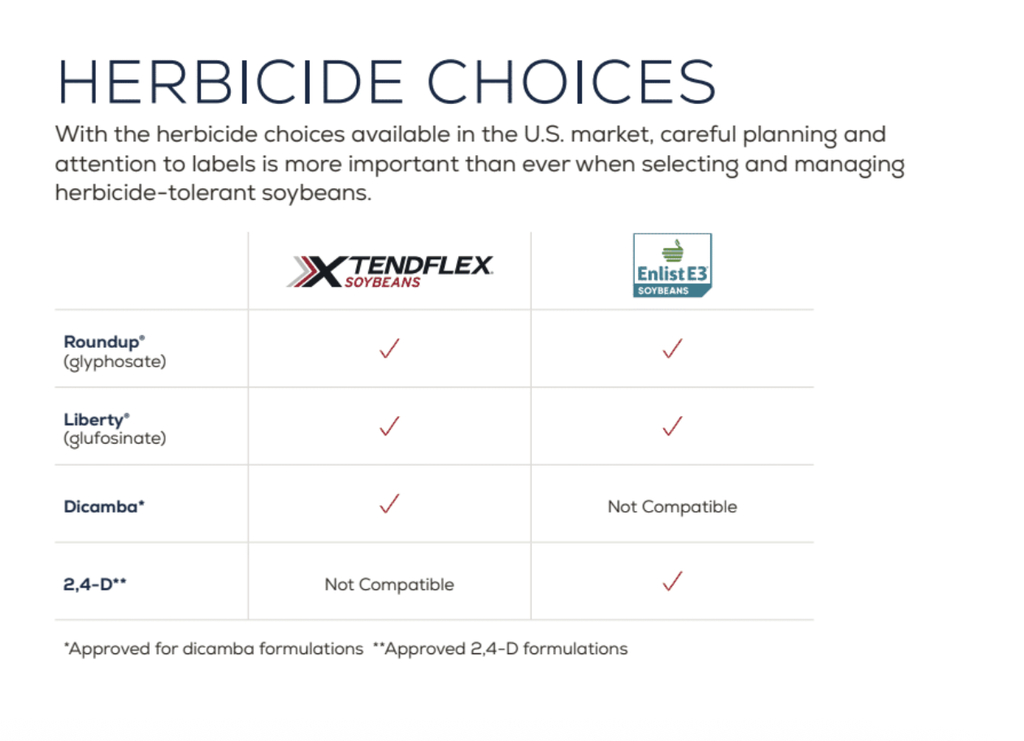
How do you match soybean herbicide traits with the right weed control program? First, identify the herbicide tolerance traits in the soybean variety you are planting. Then confirm that every planned herbicide is specifically labeled for that crop, trait system, application timing, and location. Roundup Ready 2 Xtend®, XtendFlex®, and Enlist E3® soybeans have different herbicide tolerances, and those differences determine which weed-control options growers can use safely and legally.
Choosing the right Mustang Seeds soybean variety is only the beginning. Protecting yield potential also requires an effective weed management program that fits the variety’s traits, the weeds present in the field, and current pesticide regulations.
An application mistake can result in soybean injury, poor weed control, off-target damage, and regulatory consequences.
The goal is to build a program in which the soybean genetics, herbicide tolerance traits, and weed-control practices work together.
Why Soybean Herbicide Trait Compatibility Matters
Herbicide tolerance traits allow soybean plants to tolerate specific herbicide active ingredients when those products are used according to their labels.
However, trait tolerance and herbicide registration are not the same thing.
A variety may be genetically tolerant to a herbicide, but that does not mean every formulation containing that active ingredient is approved for application over the growing crop.
Growers must confirm:
- The exact soybean trait package.
- The herbicide product’s current registration.
- Whether the product is labeled for preplant, preemergence, or postemergence use.
- Crop growth-stage restrictions.
- State and county restrictions.
- Required application equipment, buffers, weather conditions, and training.
Understanding these differences is particularly important when using dicamba- and 2,4-D-based weed-control systems.
Soybean Herbicide Trait Compatibility Chart
The following table summarizes the primary herbicide tolerances associated with three soybean trait platforms.
| Soybean trait system | Glyphosate | Glufosinate | Dicamba | 2,4-D choline |
| Roundup Ready 2 Xtend® | Tolerant | Not tolerant | Tolerant | Not tolerant |
| XtendFlex® | Tolerant | Tolerant | Tolerant | Not tolerant |
| Enlist E3® | Tolerant | Tolerant | Not tolerant | Tolerant |
This table describes genetic herbicide tolerance, not permission to apply a particular product. Only use herbicides specifically labeled and authorized for the selected soybean trait system. Verify the seed tag, current product label, and state requirements before application.
What the Chart Means for Your Farm
All three platforms provide glyphosate tolerance.
XtendFlex and Enlist E3 soybeans also provide glufosinate tolerance.
Dicamba tolerance is associated with Roundup Ready 2 Xtend and XtendFlex soybeans.
Enlist E3 soybeans provide tolerance to 2,4-D choline used in authorized Enlist herbicide products.
These distinctions should be considered before purchasing seed and developing the season’s herbicide plan.
Glyphosate Tolerance: A Common Feature Across Major Systems
Glyphosate is a Group 9 herbicide used to control susceptible grasses and broadleaf weeds.
Roundup Ready 2 Xtend, XtendFlex, and Enlist E3 soybeans all provide glyphosate tolerance.
However, glyphosate tolerance does not guarantee effective weed control.
Some weed populations, including certain waterhemp, Palmer amaranth, and horseweed populations, have developed glyphosate resistance.
Best Practices for Glyphosate Programs
- Identify the weed species present.
- Evaluate known herbicide resistance in the field.
- Use effective residual herbicides where appropriate.
- Apply postemergence herbicides when weeds are within labeled size limits.
- Combine effective herbicide sites of action when justified.
- Scout after application to evaluate control.
Glyphosate should be part of a comprehensive weed management strategy rather than the only tool used throughout the season.
Glufosinate Tolerance: XtendFlex and Enlist E3 Soybeans
Glufosinate is a Group 10 herbicide that can help manage certain weeds resistant to other herbicide groups.
XtendFlex and Enlist E3 soybeans are tolerant to glufosinate.
Roundup Ready 2 Xtend soybeans do not carry glufosinate tolerance as part of that trait package.
Do not apply glufosinate over Roundup Ready 2 Xtend soybeans unless the specific variety carries separately verified tolerance and the application is labeled.
Glufosinate Application Considerations
Glufosinate performance depends on several factors, including:
- Weed species and size.
- Spray coverage.
- Application timing.
- Weather conditions.
- Labeled application rate.
- Product-specific restrictions.
Because glufosinate primarily acts through contact activity, adequate coverage is important.
Always follow the product label for nozzle selection, spray volume, adjuvants, and environmental conditions.
Dicamba-Tolerant Soybeans: Understanding the 2026 Registration Update
Roundup Ready 2 Xtend and XtendFlex soybeans contain dicamba tolerance traits.
However, dicamba tolerance does not authorize the use of every dicamba herbicide over those crops.
Which Dicamba Products Are Approved for 2026 and 2027?
In February 2026, the U.S. Environmental Protection Agency approved three products for over-the-top application to dicamba-tolerant soybeans and cotton for the 2026 and 2027 growing seasons. [1]
The products are:
- Engenia® Herbicide, EPA Registration No. 7969-507.
- Stryax® Herbicide, EPA Registration No. 264-1241.
- Tavium® Plus VaporGrip® Technology, EPA Registration No. 100-1753.
These registrations are time-limited and subject to extensive use restrictions.
Older product registrations and historical application guides should not be used as substitutes for current labeling.
Important Dicamba Application Requirements
The 2026 federal registration framework includes requirements addressing:
- Restricted-use pesticide classification.
- Certified applicator requirements.
- Annual dicamba-specific training.
- Application rates and annual use limits.
- Approved volatility reduction agents.
- Weather and temperature restrictions.
- Drift mitigation and buffer requirements.
- Protection of sensitive plants and neighboring fields.
- State-specific restrictions.
The EPA also prohibits applications when the temperature is forecast to reach or exceed 95°F on the day of application or the following day. [1]
The current product label controls. Additional restrictions may apply, and registration does not mean an application is permitted in every location or under every set of conditions.
Why This Matters
Dicamba can injure sensitive broadleaf plants through off-target movement.
That makes product selection, application conditions, equipment setup, and compliance especially important.
Before making an application, confirm the product’s current registration and all federal, state, and local requirements.
For official information, consult the EPA’s Registration of Dicamba for Use on Dicamba-Tolerant Crops. [1]
Enlist E3 Soybeans: Understanding 2,4-D Choline Tolerance
Enlist E3 soybeans provide tolerance to three herbicide active ingredients:
- Glyphosate.
- Glufosinate.
- 2,4-D choline.
However, Enlist E3 tolerance does not mean growers can apply any 2,4-D formulation over the crop.
Which 2,4-D Products Are Authorized?
According to the Enlist weed control system’s 2026 product use guide, Enlist One® and Enlist Duo® are the authorized 2,4-D-containing herbicides for in-crop use on Enlist E3 soybeans. [2]
Enlist One contains 2,4-D choline.
Enlist Duo combines 2,4-D choline and glyphosate.
Both products have specific label requirements.
Traditional 2,4-D formulations should not be substituted for authorized Enlist products in postemergence applications.
Enlist E3 Application Considerations
Before applying an Enlist herbicide:
- Verify that the field is planted to Enlist E3 soybeans.
- Confirm the herbicide is registered for use in the state and county.
- Review the labeled crop growth-stage window.
- Check approved tank-mix partners.
- Follow nozzle, buffer, wind, and other application requirements.
- Document the application.
The Enlist system’s product guidance identifies applications through the R1 growth stage for Enlist E3 soybeans, subject to the current product label. [2]
Why 2,4-D Formulation Matters
Different formulations of the same herbicide active ingredient can have different registrations, volatility characteristics, and application requirements.
A product being labeled for preplant burndown does not automatically make it legal for postemergence use.
For Enlist E3 soybeans, use only the specifically authorized products for the intended application.
Preplant Burndown: Why Trait Compatibility Still Matters
One common misconception is that herbicide tolerance only matters after soybeans emerge.
In reality, preplant applications require careful attention to product-specific planting intervals and restrictions.
A herbicide used before planting may injure the following soybean crop if the application does not meet the label’s requirements.
Example: Dicamba Before Planting Enlist E3 Soybeans
Enlist E3 soybeans are not dicamba-tolerant.
A dicamba-containing burndown program may still be possible before planting, but only when the selected product is labeled for that use and all required plant-back intervals and conditions are satisfied.
The appropriate interval can depend on the product, application rate, rainfall, and other label-specific factors.
Do not assume that a short interval between spraying and planting is safe.
Example: 2,4-D Before Planting Dicamba-Tolerant Soybeans
XtendFlex and Roundup Ready 2 Xtend soybeans are not inherently tolerant to 2,4-D choline.
Preplant applications of 2,4-D products must follow the applicable label, including planting intervals and restrictions.
The presence of dicamba tolerance does not provide 2,4-D tolerance.
Preplant Burndown Checklist
Before spraying, verify:
- Which soybean variety will be planted.
- The variety’s herbicide tolerance traits.
- The exact burndown product and active ingredients.
- Required planting intervals.
- Application rate restrictions.
- Rainfall or environmental conditions specified by the label.
- Any additional state restrictions.
Reviewing the seed order and burndown program together can prevent avoidable mistakes.
Build a Soybean Weed Control Program Beyond Herbicide Tolerance
Herbicide-tolerant traits provide flexibility, but successful weed control depends on the entire management program.
Start With Field History
Review which weeds were difficult to control during previous seasons.
Pay particular attention to:
- Waterhemp.
- Palmer amaranth.
- Horseweed.
- Giant ragweed.
- Volunteer corn.
- Other locally important weeds.
Identify known or suspected herbicide resistance before selecting a program.
Use Residual Herbicides Where Appropriate
Soil-applied residual herbicides can help reduce early weed competition and decrease reliance on postemergence applications.
Choose products based on weed spectrum, soil conditions, crop rotation, and label restrictions.
Target Small, Actively Growing Weeds
Postemergence applications are generally more effective when weeds are within labeled size limits and environmental conditions favor control.
Waiting until weeds become large can reduce control and increase competition with the soybean crop.
Use Multiple Effective Sites of Action
Combining or rotating herbicides with different effective sites of action can help manage herbicide resistance.
However, multiple herbicides do not automatically provide multiple effective sites of action if the weed population is already resistant to one of them.
Use local resistance information when evaluating herbicide choices.
Scout After Applications
Return to treated fields to assess weed control.
Surviving weeds may indicate application problems, unfavorable conditions, late emergence, or resistance.
Document the results to improve future weed management decisions.
Herbicide Application Safety and Compliance Checklist
| Before application | What to confirm |
| Soybean variety | Exact trait package planted |
| Herbicide product | Current registration and labeled crop use |
| Application timing | Preplant, preemergence, or postemergence authorization |
| Crop stage | Growth-stage restrictions |
| Weed stage | Species and maximum labeled weed size |
| Weather | Wind, temperature, and other label requirements |
| Neighboring crops | Sensitive plants and required buffers |
| Tank mix | Approved partners, adjuvants, and mixing directions |
| Applicator | Certification and training requirements, if applicable |
| Records | Product, rate, field, timing, weather, and application details |
This checklist supports preparation but does not replace the pesticide label.
Frequently Asked Questions About Soybean Herbicide Traits
What should growers do if a field contains two different soybean trait systems?
Identify the exact boundaries of each trait system before spraying.
A herbicide authorized for one soybean trait system may severely injure plants carrying another.
If field boundaries or planting records are uncertain, do not make a trait-specific postemergence application until the crop identity is confirmed.
Maintain accurate seed and field records to avoid this problem.
Can spray tank contamination injure herbicide-tolerant soybeans?
Yes. Herbicide residues left in tanks, hoses, booms, and other equipment can injure a crop that lacks tolerance to those active ingredients.
Follow the pesticide label’s cleanout instructions when changing products or moving between fields with different trait systems.
Some products require specific cleaning procedures beyond a simple water rinse.
How can growers tell whether soybean injury came from herbicide drift or disease?
Herbicide injury and disease symptoms can overlap.
Look for patterns related to field edges, application direction, recent spraying, weather, and neighboring crops.
However, visible patterns alone may not establish the cause.
Document symptoms, application history, and environmental conditions, and consult a qualified agronomist or diagnostic laboratory when needed.
What if a herbicide is registered federally but not approved in my state?
Do not use it for that application.
Federal registration does not override state restrictions.
Some products also have county-level limitations or additional requirements.
Confirm registration and use restrictions with the state pesticide regulatory agency before purchasing or applying the herbicide.
Can soybean herbicide tolerance traits prevent herbicide-resistant weeds?
No. Herbicide tolerance protects the soybean crop from designated herbicides. It does not prevent weed populations from developing resistance.
Resistance management requires effective herbicide programs, multiple management practices, scouting, and efforts to prevent surviving weeds from producing seed.
What should farmers do if their soybean seed order changes after the herbicide program is planned?
Recheck the entire herbicide program before planting or spraying.
A replacement variety may have a different trait package, even if its maturity and agronomic characteristics are similar.
Review burndown products, residual herbicides, postemergence options, and any already completed applications.
Update field records and communicate the change to everyone responsible for spraying.
Match Soybean Traits With a Weed Control Program That Works
Soybean herbicide traits are valuable tools, but they only deliver their intended benefits when used with compatible, labeled herbicide programs.
Start by confirming the soybean variety’s trait package. Then match the herbicide products, application timing, and resistance management practices to the field’s weed-control needs.
Pay particular attention to dicamba and 2,4-D systems, where product-specific registrations and application requirements are essential.
Mustang Seeds offers soybean varieties with different trait technologies to help growers match genetics and weed management options to their operations.
Need help choosing the right soybean trait system?
Explore Mustang Seeds soybean varieties or contact Mustang Seeds to discuss your seed selection, field conditions, and weed management priorities.
References and Additional Resources
- [1] U.S. Environmental Protection Agency. Registration of Dicamba for Use on Dicamba-Tolerant Crops. View Source. Current federal information about the 2026 and 2027 dicamba registrations and application restrictions.
- [2] Corteva Agriscience. 2026 Enlist Product Use Guide. View Source. Manufacturer guidance on Enlist E3 soybean herbicide tolerance, authorized products, application requirements, and stewardship.
- [3] Bayer Crop Science. XtendFlex Soybeans. View Source. Manufacturer information about XtendFlex herbicide tolerance.
- [4] Corteva Agriscience. Enlist E3 Soybeans. View Source. Manufacturer information about Enlist E3 herbicide tolerance and weed-control options.
- [5] Michigan State University Extension. Weed Control in Enlist E3 Soybeans. View Source. Background on residual herbicides, postemergence programs, and resistance management. Consult the current annual guide for application recommendations.
- [6] University of Florida IFAS Extension. Using 2,4-D Choline Herbicide Products on 2,4-D-Tolerant Crops. View Source. Guidance on 2,4-D choline formulations and crop-specific use.
- [7] Mustang Seeds. Soybean Seed. View Source. Soybean variety information and available trait systems.
- [8] Mustang Seeds. 2026 North Seed Guide. View Source. Mustang Seeds soybean varieties and technology information.
- [9] Mustang Seeds. Agronomy Resources. View Source. Crop management and seed selection resources.
About Mustang Seeds
Mustang Seeds is an agricultural seed company serving growers with corn, soybean, forage, and other seed solutions. With an emphasis on locally relevant genetics, agronomic knowledge, and grower relationships, Mustang Seeds helps farmers evaluate seed options for their individual operations.
From seed selection and crop management information to local performance data, Mustang Seeds provides resources designed to support informed decisions throughout the growing season.
Explore Mustang Seeds:
- Mustang Seeds Homepage
- Corn Seed
- Soybean Seed
- Agronomy Resources
- Local Plot Data
- Contact Mustang Seeds
Every acre is different. Find the seed and agronomic support that fits yours.
Herbicide Stewardship and Trademark Information
ALWAYS READ AND FOLLOW PESTICIDE LABEL DIRECTIONS.
Herbicide tolerance traits do not authorize applications of products that are not registered and labeled for the intended use.
Product registration, application restrictions, and stewardship requirements may change. Confirm current federal, state, and local requirements before making an application.
Roundup Ready 2 Xtend®, XtendFlex®, and Roundup® are trademarks of Bayer Group. Enlist E3®, Enlist One®, and Enlist Duo® are trademarks of Corteva Agriscience and their respective owners. Liberty® is a trademark of BASF. Other trademarks belong to their respective owners.
Herbicide performance and crop response may vary with environmental conditions, weed pressure, application practices, and management.